Tuesday · Thursday周二 · 周四
8:00–9:00 PM ET2 sessions / week · 15 sessions in 8 weeks每周 2 次 · 8 周完成 15 次课
Cohort starts Sep 12 · First live class Sep 15班期 9 月 12 日开始 · 首次直播课 9 月 15 日 Merit PointResearch Lab · 恒点学术Join the Lab
COURSES · 课程
Courses are not knowledge packages separated from projects. They are a training system designed for research practice, with entry points matched to each student’s preparation.课程不是独立于项目的“知识包”,而是为研究实践服务的训练系统。学生可以从适合自己的阶段进入,再逐步进入独立项目。
AI TOOLBOX ONLINE · 开班课表
Includes all 15 live sessions包含全部 15 次直播课
The Fall online cycle begins September 12, 2026. The weekend cohort meets that day; Tuesday/Thursday live classes begin September 15. Both formats advance at two sessions per week and complete the same 15-session research pathway in the same teaching cycle.秋季线上班期于 2026 年 9 月 12 日开始:周末班当天首课,周二/周四平时班于 9 月 15 日首课。两种班型均按每周两节推进,在同一教学周期内完成相同的 15 次课科研路径。
2 sessions / week · 15 sessions in 8 weeks每周 2 次 · 8 周完成 15 次课
Cohort starts Sep 12 · First live class Sep 15班期 9 月 12 日开始 · 首次直播课 9 月 15 日1 block / week · 2 sessions per block · 8 weeks每周 1 次 · 每次两节 · 8 周完成
First live class: September 12, 2026首次直播课:2026 年 9 月 12 日2026–27 ANNUAL INTAKES · 全年班期
Weekday first class Sep 15 · Weekend first class Sep 12平时班首课 9 月 15 日 · 周末班首课 9 月 12 日
Weekend finishes Oct 31; weekday finishes Nov 3. Both cover the same 15-session pathway at two sessions per week.周末班 10 月 31 日完成,平时班 11 月 3 日完成;两班均按每周两节完成同一套 15 次课。Weekday first class Mar 2 · Weekend first class Feb 27平时班首课 3 月 2 日 · 周末班首课 2 月 27 日
Both formats follow the same two-session-per-week learning pace.两种班型保持每周两节的同一学习进度。July–August · Summer project cycle7–8 月 · 暑期项目周期
Exact dates will be published during the Spring enrollment cycle.准确日期将在春季招生周期内公布。All class times are Eastern Time (ET). Calendar invitations adjust automatically to each family’s local time zone.所有上课时间均为美东时间(ET);日历邀请会自动转换为家庭所在地时区。
COURSE SYLLABI · 课程大纲
Beginner Roblox gives Grades 4–9 an early, project-driven bridge into coding, game development, and research habits. The Physical AI program develops robotics, autonomous systems and research skills in three stages of 15 sessions each. The later pathways build toward independent research, while the 1:1 Studio schedule is finalized after a readiness assessment. Expand a course to view its full syllabus and milestone deliverables.Beginner Roblox 为 4–9 年级学生提供一条项目驱动的早期入口,把编程、游戏开发与科研习惯连接起来;具身智能培养体系以三个阶段、每阶段 15 次课,连接机器人开发、AI 自主系统与创新研究。一对一科研项目的具体节奏会在能力评估后确定。展开课程即可查看完整大纲与阶段成果。
12 sessions · Grades 4–9 · Beginner-friendly12 次课 · 4–9 年级 · 零基础友好
Students use Roblox Studio and Luau to build, test, and improve playable games. Each project links coding concepts to playtesting evidence, ending with an original game and a concise design report.使用 Roblox Studio 与 Luau 设计、编写、测试和改进可玩的游戏。每个项目都把编程概念与试玩证据连接起来,最终完成一款原创游戏和简明设计报告。
Who it is forFor students in Grades 4–9 who want to turn an interest in games into structured design, coding, and investigation. No Roblox Studio experience is required; students need access to a computer that can run the current Roblox Studio.适合人群面向希望把游戏兴趣转化为系统设计、编程与探究能力的 4–9 年级学生;无需 Roblox Studio 经验,但需要使用能够运行当前 Roblox Studio 的电脑。
课程详情Roblox Studio workspace, parts, materials, coordinates, safe asset use, play mode, and a step-by-step obstacle-course build.Roblox Studio 工作区、零件、材质、坐标、安全使用素材、试玩模式,以及分步骤搭建障碍赛。
A themed obstacle course with checkpoints and a build log带检查点的主题障碍赛与制作记录
Variables, conditions, functions, loops, events, and debugging through doors, hazards, collectibles, and moving platforms.通过门、机关、收集物和移动平台学习变量、条件、函数、循环、事件与调试。
A coded interaction level with a tested mechanic set包含多种已测试机制的编程互动关卡
Scoring, timers, user-interface feedback, object cloning, round logic, leaderboards, and structured playtests with classmates.计分、计时、界面反馈、物体克隆、回合逻辑、排行榜,以及与同学开展结构化试玩。
A multiplayer-ready prototype and playtest observation sheet可进行多人测试的原型与试玩观察表
Game pitch, scope, implementation, bug tracking, player-feedback analysis, revision, responsible publishing, and presentation.游戏提案、范围控制、实现、缺陷记录、玩家反馈分析、迭代、负责任发布与展示。
Original playable game, design report, playtest evidence, and live showcase原创可玩游戏、设计报告、试玩证据与现场展示
15 sessions · Beginner-friendly15 次课 · 零基础友好
Beginning with a research question, students move through data, models, experiments, and communication to complete a well-structured mini study.从提出问题开始,完整走过数据、模型、实验与表达,完成一项结构完整的 Mini Study。
Who it is forBest for students who are new to research or need a structured introduction to data-driven investigation.适合人群适合初次接触科研,或希望系统建立数据研究基础的学生。
课程详情Question framing, source credibility, search strategies, reading notes, and responsible use of AI tools.问题界定、来源可信度、检索策略、阅读笔记,以及负责任地使用 AI 工具。
Research-question brief and annotated reading map研究问题简报与带注释的阅读图谱
Dataset documentation, cleaning, variables, missingness, visualization, and the difference between observation and explanation.数据集说明、清洗、变量、缺失值、可视化,以及“观察结果”与“解释原因”的区别。
Auditable data notebook with a data dictionary可复核的数据分析笔记与数据字典
Train/test separation, simple baselines, foundational models, evaluation metrics, and avoiding data leakage.训练与测试划分、简单基线、基础模型、评估指标与数据泄漏防范。
Baseline experiment and results table基线实验与结果表
Changing one factor at a time, interpreting failures, checking subgroup behavior, and recording limitations.一次改变一个因素、分析失败案例、检查分组表现,并如实记录局限。
Comparison figure, error log, and limitations memo比较图、误差记录与局限说明
Methods and results writing, figure captions, citations, poster design, presentation, and revision after feedback.方法与结果写作、图注、引用、海报设计、口头展示与反馈后修改。
Mini-study report, poster, presentation, and reproducibility folderMini Study 报告、海报、展示与可复现材料文件夹
15 sessions · Advanced project track15 次课 · 进阶项目制
Centered on machine learning and perception, this track covers baseline reproduction, controlled experiments, error analysis, and rigorous research writing.以机器学习和感知为主线,完成基线复现、受控实验、误差分析与规范研究写作。
Who it is forBest for learners with basic Python and data-analysis experience who are ready to reproduce and extend recent research.适合人群适合具备基础 Python 与数据分析经验,准备复现并延伸较新研究工作的学习者。
课程详情Reading a recent paper critically, tracing prior work, identifying the claimed contribution, and defining a feasible reproduction target.批判性阅读较新论文、梳理前序工作、识别论文贡献,并界定可行的复现目标。
Paper map, claim–evidence table, and reproduction protocol论文脉络图、主张—证据表与复现方案
Reproducible setup, dataset lineage, implementation checks, metric matching, and documenting deviations from the source paper.可复现环境、数据来源、实现核查、指标对齐,以及记录与原论文不一致之处。
Working baseline, run log, and reproduction report可运行基线、实验日志与复现报告
Turning a limitation or unresolved result into a testable hypothesis, selecting controls, and preregistering comparisons.把局限或未解决结果转化为可检验假设,选择对照条件,并预先写清比较方案。
Extension proposal and experiment matrix延伸研究方案与实验矩阵
Ablation studies, sensitivity checks, error analysis, negative results, and deciding what the evidence actually supports.消融实验、敏感性检查、误差分析、负面结果,以及判断证据实际能够支持什么。
Results package with figures, tables, and decision log包含图表与决策记录的结果包
Academic structure, methods transparency, claims and limitations, internal peer review, revision, and responsible authorship discussion.学术结构、方法透明度、主张与局限、内部同行评议、修改,以及负责任的署名讨论。
Extended abstract or manuscript draft with reproducibility materialsExtended Abstract 或论文初稿及可复现材料
Personalized timeline · Faculty mentorship个性化周期 · 导师制
A personalized topic and timeline connect technical training, project development, and research communication around each student’s preparation and interests.根据学生基础、兴趣和时间线定制课题,把训练、项目推进和成果表达连成一条路线。
Who it is forBest for students and emerging researchers who need a topic, pace, and research plan matched to their preparation and goals.适合人群适合需要根据个人基础与目标定制选题、节奏和研究计划的学生及新兴研究者。
课程详情Technical baseline, research interests, time constraints, target outcomes, and a realistic project scope.技术基础、研究兴趣、时间约束、目标成果与现实可行的项目范围。
Individual learning and research roadmap个人学习与科研路线图
Recent anchor paper, prior work, current project activity, unresolved gap, and question feasibility.较新的锚点论文、前序工作、当前项目进展、尚未解决的空白与问题可行性。
Annotated literature map and project brief带注释的文献图谱与项目简报
Dataset and code audit, reproducible environment, baseline implementation, experiment log, and mentor review.数据与代码审计、可复现环境、基线实现、实验日志与导师评审。
Auditable baseline package可复核的基线材料包
Hypothesis design, controlled comparisons, iteration, error analysis, research meetings, and evidence boundaries.假设设计、受控比较、研究迭代、误差分析、研究会议与证据边界。
Results package and research review presentation结果材料包与研究评审汇报
Manuscript or portfolio development, internal review, revision, authorship criteria, and whether the work is ready for external submission.论文或研究档案形成、内部评审、修改、署名标准,以及是否具备对外投稿条件。
Manuscript draft or portfolio artifact with a documented next-step plan论文初稿或研究档案成果及有记录的下一步计划
8 sessions · 75 minutes each · Ages 9–14 · Live online8 次课 · 每次 75 分钟 · 9–14 岁 · 在线直播
Program lights, games and music with MakeCode Blocks, then bring the same logic to a robot that moves, avoids obstacles, follows a line and parks. Eight 75-minute online classes build toward an independent robot challenge and a documented portfolio.使用 MakeCode 图形化积木编写灯光、游戏与音乐,再用同样的逻辑让小车运动、避障、循线与停车。八次 75 分钟在线课,逐步完成自主机器人挑战与有证据的作品集。
Who it is forFor beginners aged 9–14 who can use a mouse and browser independently. Each student needs a micro:bit V2/V2.2, a computer and a USB data cable; add an ELECFREAKS Cutebot from lesson 4.适合人群适合 9–14 岁、能独立使用鼠标和浏览器的零基础学生。每人需自备 micro:bit V2/V2.2、电脑和 USB 数据线,第 4 次课起使用 ELECFREAKS Cutebot。
课程详情Sequence, inputs and outputs, the LED matrix, loops, downloading and saving.程序顺序、输入与输出、LED 点阵、循环、下载与保存。
A scrolling name + your own animated icon.滚动姓名 + 自定义图标动画。
Events, random numbers, variables, if/else and the accelerometer.事件、随机数、变量、if/else 条件与加速度计。
Shake-to-play rock–paper–scissors; an optional step counter.摇一摇电子石头剪刀布;可选计步器。
Loops, pauses, reusable functions, sound and synchronized animation.循环、暂停、函数与片段复用、声音和同步动画。
A 20–40-second performance you compose.一段自己编排的 20–40 秒声光表演。
Motors, speed, sequence, time and distance, and calibration.电机、速度、顺序、时间与距离,以及校准。
Forward. Turn. Return. Stop. A route you can repeat.前进、转弯、返回、停车:走出可重复的规定路线。
Ultrasonic distance, thresholds, continuous sensing and sense–decide–act.超声波测距、阈值、持续检测,以及感知—决策—动作。
Sense an obstacle, stop, reverse and turn.发现障碍后自动停车、后退并转向。
Two sensors, four states, Boolean logic, feedback, and speed versus stability.双传感器、四种状态、布尔逻辑、反馈,以及速度与稳定性的权衡。
One complete taped lap, without a helping hand.沿黑色胶带路线跑完一圈,无需手碰车体。
Multiple conditions, states, modularity, user feedback and system testing.多条件、状态、模块化、用户反馈与系统测试。
Approach, signal, slow down and park at a safe distance.驶入停车区,分级提示、减速,并在安全距离停车。
Design, integration, testing, iteration and explaining your decisions.设计、整合、测试、迭代与设计说明。
Your own project, a 60–90-second video and a two-minute live demo.自主项目、60–90 秒视频,以及 2 分钟现场演示。
3 stages × 15 sessions · 45 sessions · 90 classroom hours三个阶段 × 每阶段 15 次课 · 共 45 次 · 约 90 课堂小时
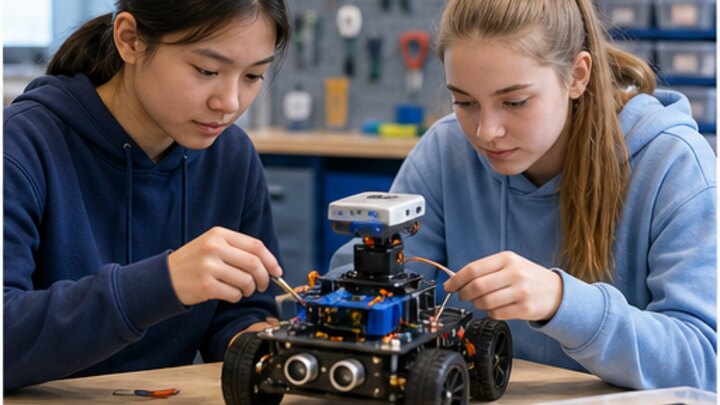
Build and program an ELEGOO robot, develop vision and autonomous agents on a computer, then investigate robot learning and VLA through simulation and a reproducible research project.从 ELEGOO 小车组装与控制出发,在电脑上开发视觉、AI 模型和自主 Agent,再通过仿真、机器人学习与 VLA 专题完成研究型项目。每阶段 15 次课,独立设定入门要求、成果与进阶验收。
Who it is forA progressive pathway from robotics beginners to learners ready for Python, machine learning and supervised research. Entry to later stages is based on a practical readiness review.适合人群从机器人入门逐步进阶到 AI 开发与研究实践;可按能力评估进入相应阶段。高级阶段需具备 Python、机器学习与基础数学准备。
课程详情Programming and assembly; motor and sensor calibration; line following, obstacle handling and measured testing.掌握机器人基础、编程和硬件开发,能独立解释、组装、调试一个感知—决策—执行闭环。
An assembled and tested robot with an engineering notebook循线与遇障停车挑战车:自行组装的机器人、版本与接线记录、测试视频、工程日志和项目说明。
Python data workflows, computer vision, small models and PyTorch; messages, planning, constrained agent tools and closed-loop evaluation.掌握 AI 模型、计算机视觉、AI Agent 和自主机器人开发的基本流程,把感知、规划、工具调用和执行反馈连接成可测试的系统。
A vision-guided agent in a tested autonomous simulation, with optional validated hardware integration视觉导航任务助手:电脑端感知模型、带约束的任务 Agent、本地仿真闭环、测试集与数据/模型说明卡;条件具备时迁移到小车。
MuJoCo episodes, demonstrations, behavior cloning, closed-loop and RL comparisons, VLA interfaces, generalization and reproducible research.理解 VLA、机器人学习与仿真的核心方法;完成一个问题明确、对照公平、结果可复现的研究型项目,并能判断结论的适用范围。
A reproducible robot-learning study with a report, poster and independent rerun小型机器人学习研究:规则控制与学习策略的受控比较、完整回合数据、实验配置、结果图、4–6 页报告、海报和复现包。
Topics may be adjusted to match learner readiness, project data, and mentor review. Completion of a course or project does not guarantee publication, authorship, admission, employment, awards, or academic credit.具体内容可根据学习者基础、项目数据与导师评审进行调整。完成课程或项目不代表保证发表、署名、录取、就业、奖项或学分。
A research-readiness assessment considers technical background, interests, weekly availability, and application timeline to recommend a concrete starting point.科研能力评估会结合基础、兴趣、每周时间和申请节奏,给出具体起点建议。
Take the assessment开始科研能力评估→JOIN THE LAB · 加入实验室
Tell us about your current stage, background, interests, and timeline. We will recommend an appropriate track, research direction, and project starting point.告诉我们您目前所处阶段、基础、兴趣与时间线,我们会建议适合的培养路径、研究方向和项目起点。
View joining options查看加入方式→